
Short-Lived truce, U.S. blockade, yield reversal: A high-tension week
The week of April 7–11 was dominated by an unprecedented geopolitical sequence: a ceasefire announced on April 8 between Washington and Tehran, followed by an immediate reversal with the U.S. blockade of Iranian ports. Markets swung sharply, oil plunged before rebounding, and sovereign yields moved in a rollercoaster pattern.
Review of the past week
→ The week began in continuity with geopolitical stress: the U.S. ultimatum to Iran weighed on markets, Brent remained above $110, and the CAC 40 hovered around 7,900 points.
The turning point came on Wednesday, April 8, with the announcement of a two-week truce between the United States, Israel, and Iran, conditional on the partial reopening of the Strait of Hormuz. Brent immediately dropped by nearly 14% in a single session, while equity markets rallied sharply.
However, the relief proved extremely short-lived. Weekend negotiations in Islamabad failed, prompting Washington to announce a full blockade of Iranian ports effective Monday, April 13. Oil prices rebounded as early as April 12.
This sequence perfectly illustrates the oil–rates–equities correlation: when Brent declines, sovereign yields ease and equity markets rebound, and vice versa.
Key figures
• CAC 40
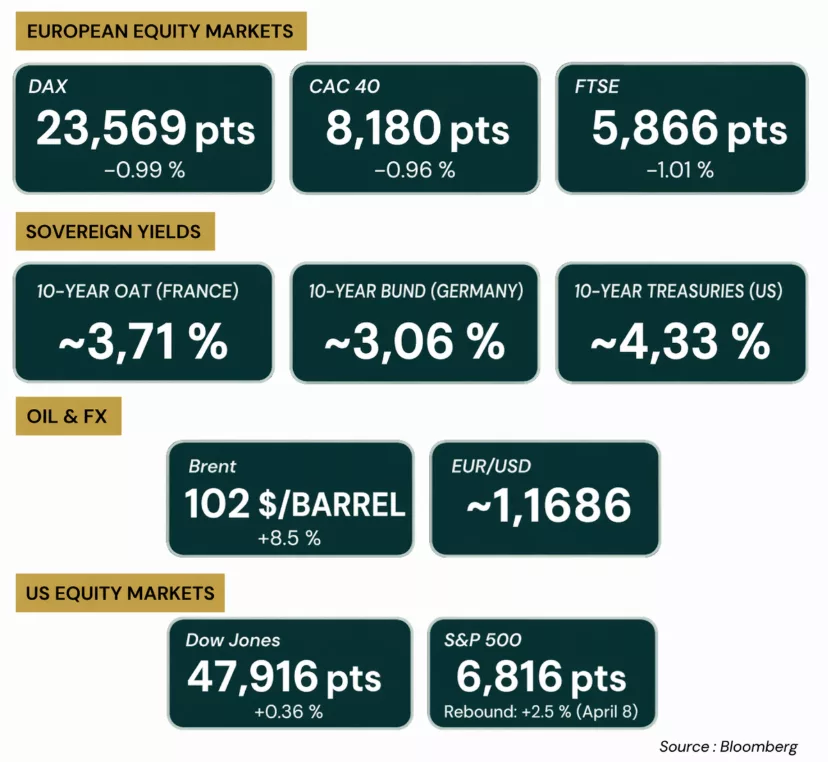
04/06: −0.67% → 7,909 pts | 04/08: +4.5% | 04/10: +0.3% → 8,268 pts
• Brent crude
04/06: ~ $112/barrel → 04/08: ~ $93 → 04/10: $97
• 10-year OAT (France)
04/06: 3.68% → 04/08: 3.52% → 04/10: 3.70%
• 10-year German Bund
04/06: 2.99% → 04/08: temporary easing → 04/10: 3.03%
• 10-year U.S. Treasury yields
04/08: slight easing post-truce → 04/10: rapid return to around 4.33%
Current policy rates overview
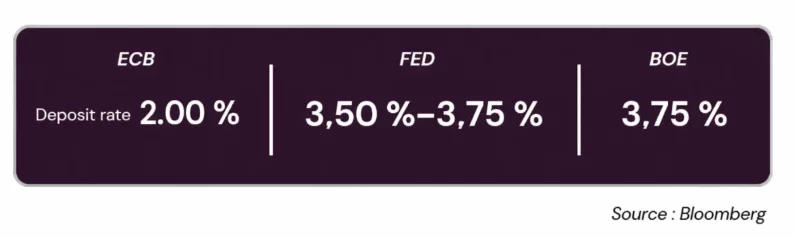
→ Central banks remained on hold, but constrained. The Federal Reserve continues to maintain a restrictive stance, with no rate cuts expected in the near term. The European Central Bank remains under inflationary pressure, with at least two rate hikes anticipated by the end of 2026.
Summary of key figures for the week of April 13
Outlook and implications for treasurers
Markets are entering a phase of extreme geopolitical binary risk: any announcement regarding the Strait of Hormuz can move Brent by 10–15% in a single session and sovereign yields by 20–25 basis points.
Scenario 1: Confirmed escalation (sustained blockade)
Brent would remain above $105–115, generating persistent inflationary pressure and forcing the ECB to maintain, or even tighten, its stance. The 10-year OAT would exceed 3.80%, with rising funding costs and widening NEU CP spreads. The CAC 40 would fall below 8,000 points, with renewed systemic stress and a higher equity risk premium.
→ Secure issuance windows without delay, extend maturities where possible, and diversify counterparties.
Scenario 2: Solid diplomatic agreement (resolution within 2–4 weeks)
Brent would fall back below $85–90, easing inflationary pressures and allowing the ECB to consider moderate easing by the end of 2026. The OAT would decline toward 3.30–3.50%, reopening attractive issuance windows. The CAC 40 would move back above 8,300–8,500 points, supported by renewed risk appetite.
→ Take advantage of low-rate issuance windows, recalibrate interest rate hedging, and reduce oil exposure through hedging strategies.
Scenario 3: Volatile status quo (base case)
Alternating truces and breakdowns would keep Brent in a $90–110 range. Cost visibility would remain structurally impaired, with yields staying in a high range (OAT between 3.50% and 3.90%), limiting issuance to tactical windows. Working capital requirements would remain under pressure, with volatile input costs and unpredictable operating cash flows.
→ Manage liquidity tactically, maintain precautionary buffers, and avoid unhedged long exposures.