
Green and sustainable finance is attracting investors by integrating ESG criteria into investment decisions. Investors are seeking opportunities that combine positive ESG impact with competitive financial returns. This growing interest is driven by the increasing consideration of ESG criteria, as highlighted in a study by PwC.
69% of asset management companies believe that ESG criteria are essential for value creation. Moreover, 56% of investors have already abandoned transactions due to ESG-related concerns. This article explores how green and sustainable finance contributes to an optimal allocation of resources, ensuring both financial and non-financial performance for all stakeholders.
In light of these considerations, it is essential to take a closer look at how green and sustainable finance can truly shape overall corporate performance. By aligning financial interests with societal and environmental imperatives, it becomes a driving force in optimizing resource allocation. The balance between financial profitability and social responsibility meets the diverse expectations of stakeholders, reinforcing green and sustainable finance as a catalyst for sustainable change.
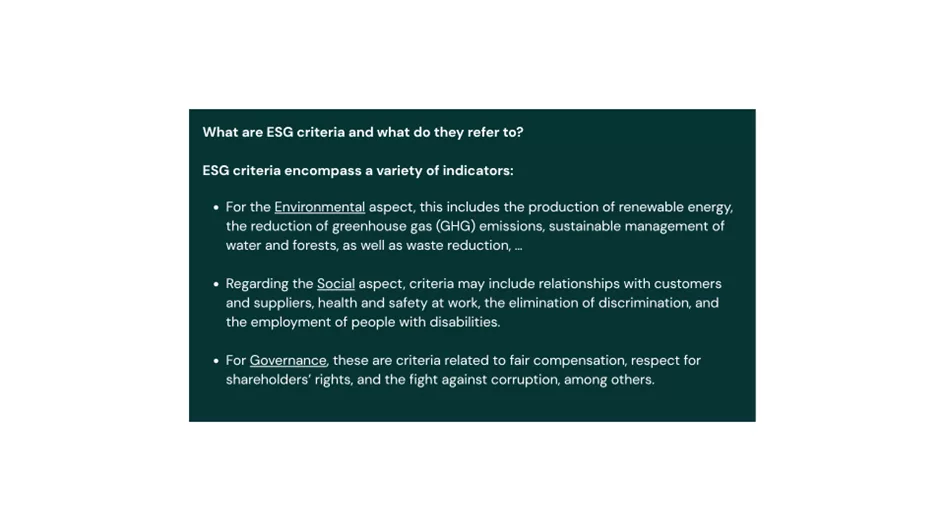
Green financial instruments represent a wide range of products designed to channel capital toward environmentally beneficial projects and companies. Below are some examples:
Green bonds
Green bonds are debt securities issued by public or private entities to finance environmentally sustainable projects. The funds raised are specifically allocated to initiatives such as renewable energy, energy efficiency, or sustainable water management.
Ethical and sustainable mutual funds (FCPs)
Ethical and sustainable mutual funds are investment vehicles that select companies based on ESG criteria. These funds prioritize investments in companies demonstrating responsible business practices across environmental, social, and governance dimensions.
Sustainable equities
Sustainable equities are shares issued by companies committed to responsible business practices. Investors aim to support firms whose activities contribute positively to sustainability, such as those involved in renewable energy, clean technology, or biodiversity conservation.
Social bonds
Social bonds are financial instruments issued by public or private entities to finance social projects. The funds raised are dedicated to initiatives such as employment, education, social housing, or disaster response. These bonds allow investors to support social causes while generating financial returns, thereby promoting social responsibility and sustainability.
SRI money market funds (SFDR Article 8)
Money market funds classified under Article 8 of the SFDR indicate a strong commitment to ESG criteria. These funds invest in money market instruments while adhering to socially responsible investment principles.
ESG term deposits
An ESG term deposit is specifically designed to enable companies to invest surplus cash with a focus on responsible investments aligned with ESG criteria. Funds placed in “Responsible” term accounts are used by banks to finance borrowers committed to achieving social or environmental performance targets through impact loans, offering a dual opportunity for financial return and positive impact.
Companies are encouraged to consult specialized advisory teams to guide them in selecting and using these products.
These examples illustrate the diversity of green financial instruments available, offering investors and companies multiple ways to actively contribute to environmental sustainability.
Main sustainable investment strategies
Given the diversity of investment strategies, there are also multiple approaches to integrating ESG criteria:
- Best-in-class approach: prioritizes companies with the highest ESG ratings within each sector, without excluding any sector a priori. Companies are assessed relative to their industry peers, and lower-rated ones are excluded. This is a widely adopted approach.
- Best-in-universe approach: selects top-performing companies in terms of ESG across all sectors, regardless of industry. This may lead to overexposure to traditionally “virtuous” sectors while excluding others undergoing significant transition challenges.
- Best-effort approach: favors companies that have demonstrated continuous improvement in their ESG performance over time.
- Thematic approach: targets companies operating in sectors directly linked to sustainable development, excluding others. Green funds are a typical example of this strategy.
Link between green finance and non-financial performance
The convergence between green finance and non-financial performance relies on several key factors. First, engaging in green finance initiatives often requires aligning financial objectives with ESG considerations. Companies adopting green finance practices demonstrate responsible management of natural resources and strive to minimize their environmental footprint.
Additionally, the pursuit of green financing stimulates innovation in sectors such as renewable energy, fostering sustainable solutions that enhance non-financial performance.
Case studies, such as Tesla’s successful transition to electric vehicles, Unilever’s responsible supply chain strategy, and green bond issuances by BNP Paribas, illustrate the correlation between green finance and non-financial performance.
These synergies provide distinct competitive advantages, including enhanced brand reputation, privileged access to fast-growing markets for responsible products, and the ability to attract talent motivated by ethical values and sustainability goals, thereby strengthening human capital.
Implementation of ESG criteria
The practical implementation of ESG criteria in investment processes relies on various tools to assess programs, conduct audits, and integrate ESG at both fund and portfolio company levels.
Dedicated ESG audits strengthen due diligence processes by providing an in-depth understanding of ESG-related risks and opportunities. Key areas of analysis include ESG strategy, policies, and performance indicators of target companies.
At the time of investment, target companies often commit to implementing ESG criteria, including appointing a Corporate Social Responsibility (CSR) officer and adjusting governance structures post-closing. Investors incorporate ESG clauses into investment agreements, requiring regulatory compliance, adherence to group policies, and the use of key performance indicators (KPIs) to ensure effective implementation.
The trend toward voluntary adoption of ESG regulations is accelerating, while binding regulatory frameworks are becoming more stringent, increasingly influencing companies seeking financing.