Geopolitical turbulence: Protecting your portfolio against war risk
Wars leave indelible marks on global economies and significantly influence financial markets. The ongoing conflicts in the Middle East resonate strikingly with the economic disruptions caused by wars of the past. One alarming statistic illustrates this: according to a study by the Cologne Institute for Economic Research (IW), the economic cost of the war in Ukraine amounted to $1.6 trillion in 2022 ¹.
These figures highlight the striking similarities between the economic repercussions of current conflicts in the Middle East and those of the past, which have profoundly shaped the global economy. The ongoing conflicts in the region extend beyond their borders and influence global economies, generating volatility that investors and financial decision-makers cannot ignore. At the opening of an investment conference in Saudi Arabia on October 24, 2023, World Bank President Ajay Banga expressed serious concerns about the economic consequences of the ongoing conflict in the Middle East. He warned that what is happening in Israel and Gaza will have an impact on economic development, emphasizing the need to adopt financial management strategies to address this crisis.
The current situation remains unclear, but a wider conflict represents heightened risks. This uncertainty can be compared to the Yom Kippur War in 1973, when the Arab members of OPEC imposed an oil embargo against supporters of Israel. This embargo led to a spectacular surge in oil prices of over 300%, triggering marked inflation, an economic recession, and stock markets in freefall.
¹ Röhl, Klaus-Heiner / Bardt, Hubertus / Engels, Barbara, 2023, A New Era for the Defense Industry? Security Policy and Defense Capability after the Russian Invasion of Ukraine, IW-Policy Paper, Nr. 2, Berlin / Cologne
Impact on financial management and investments
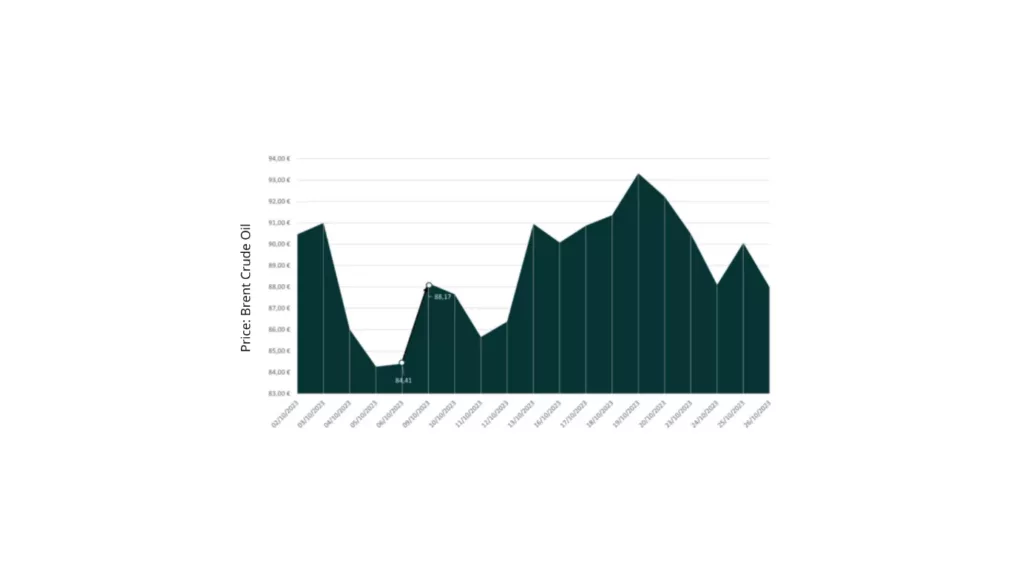
Middle Eastern conflicts have historically caused increased volatility on global financial markets. Investors become nervous in the face of uncertainty, which often translates into sharp fluctuations in equity prices, currencies, and commodities. A concrete example of this volatility emerged on Monday, October 9th, when oil prices surged by more than 4% (see Fig. 1), raising concerns about supply disruptions from the oil-rich region.
However, the impact of Middle Eastern conflicts is not limited to oil markets. Global geopolitical repercussions represent another major concern. Relationships between countries and strategic alliances can be redefined, directly affecting global markets and capital flows. Investors must therefore pay close attention to these shifts, which can influence the performance of their investments.
How to protect assets against an international conflict
In light of growing economic concerns linked to the ongoing conflict in the Middle East, it is crucial to implement robust financial management strategies to minimize risks and preserve economic stability.
Controlling the food supply:
Certain companies in the agri-food sector tend to be considered relatively resilient in times of crisis, including wartime, due to the continued demand for basic food products. Food is an essential commodity, and baseline demand for it generally does not decline significantly even during periods of war. However, investing during wartime can be risky for many other reasons, including market volatility, supply chain disruptions, and political decisions such as requisitions.
Diversification:
Diversification plays a central role in these strategies. It allows investors to spread their funds across a variety of asset classes, including equities, bonds, commodities, and others, creating a natural hedge against potential losses. Geographic diversification is equally essential, reducing exposure to a specific conflict by investing in international markets. Sector diversification also helps to mitigate the impact on conflict-sensitive sectors. This comprehensive approach aims to minimize potential losses while maintaining portfolio stability.
Precious metals:
Gold and silver have historically served as safe-haven assets during periods of crisis. They can act as a buffer against conflict-related financial volatility and help protect asset values. Precious metals act as a hedge against currency depreciation. During conflicts, governments may be compelled to devalue their currency to meet military costs, which can erode investors’ purchasing power. Gold and silver, by contrast, retain their value.
Staying out of conflict zones:
Certain countries, such as Switzerland or Ireland, have a well-established reputation for minimal involvement in global conflicts. Government bonds from these countries, or certain of their assets, could represent an opportunity in times of war. While these countries will not be entirely shielded from the economic impact of a global conflict, the impact could be more limited and the return to a normal economy faster.
Options and futures contracts:
Options and futures contracts can be used to hedge against fluctuations in equity prices and currencies, providing a degree of stability to a portfolio. They also enable the implementation of strategies designed to profit from market downturns.
Investing in the war economy:
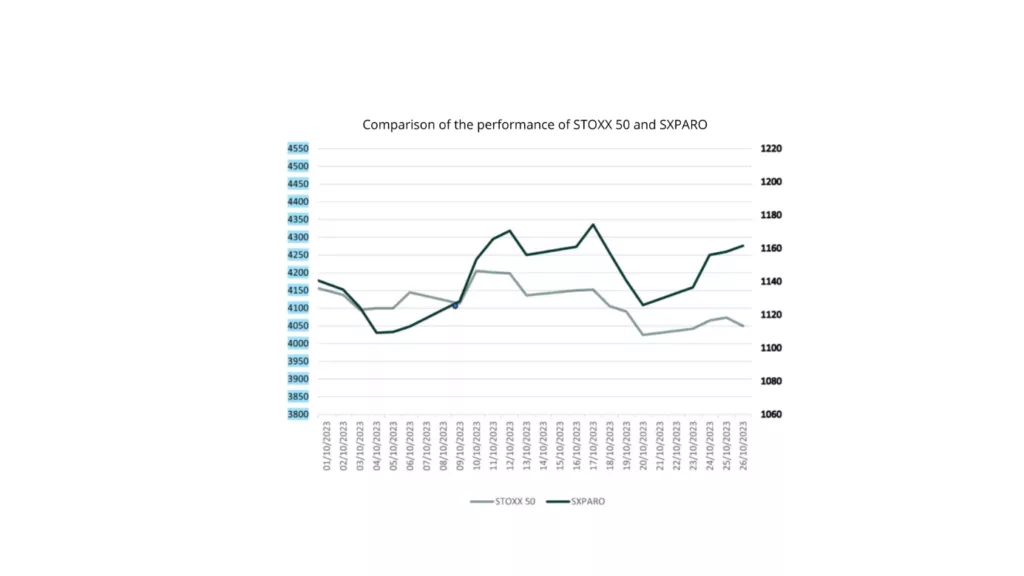
The Aerospace and Defense sector can represent an opportunity in times of armed conflict. A striking example is the impact of conflicts in Europe and the Middle East on shares of Dassault Aviation, which reached a five-year high of €192.00 per share. Another factor supporting this perspective is the recent performance of the STOXX® Europe Total Market Aerospace and Defense Index, which rose from €1,113.00 on October 6, 2023 to €1,174.35 on October 17, 2023 (see Fig. 2), a gain of +5.51% as a result of the Middle East conflict. The one-year performance of the index stands at +32.30% (compared to +11.54% for the Euro Stoxx 50, the non-sector-specific eurozone index), confirming the health of this sector in the context of rising international tensions.
Comparison chart of the two indices: