Towards a strong banking union: Key proposals from french banks
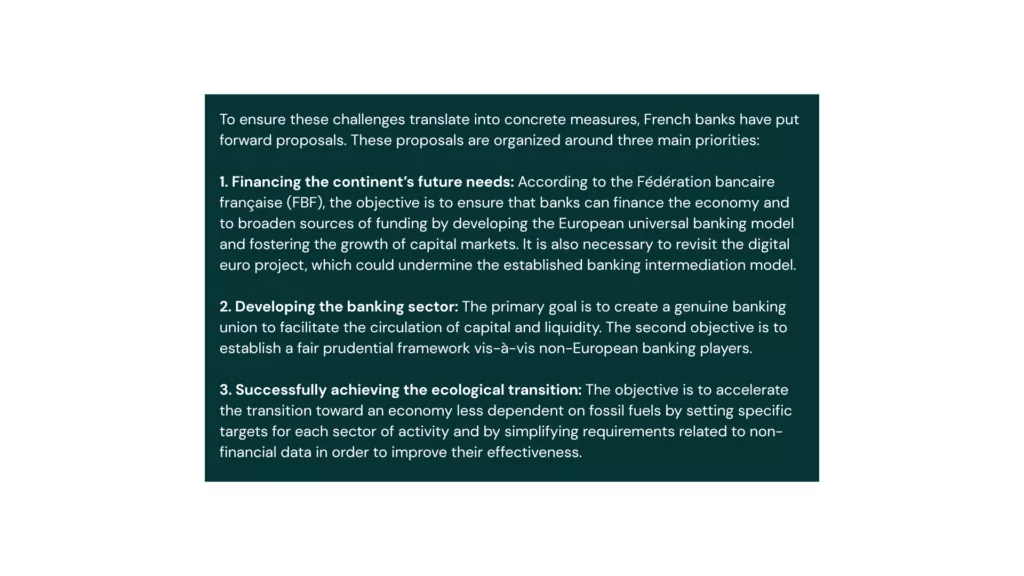
The Fédération bancaire française (FBF) has published a document entitled “For a Sovereign and Sustainably Growing Europe”, outlining the proposals of French banks for the 2024–2029 period. This document is presented as a contribution to building a sovereign Europe with the objective of sustainable growth. It highlights the challenges facing the European banking sector, including the need to finance environmental and digital transitions, as well as to strengthen the competitiveness of the EU economy.
Regarding European legislation that may affect the sector’s competitiveness, the European Commission has adopted a reform of EU banking regulation aimed at strengthening the resilience and sustainability of the sector. This reform, known as the 2021 Banking Package, seeks to implement the Basel III agreement while taking into account the specific characteristics of the European banking sector. The objective is to ensure that EU banks become more resilient to potential future economic shocks, while supporting Europe’s recovery after the COVID-19 pandemic and facilitating the transition to climate neutrality.
Financing capacity within the European Union
To support the financing of the economy, the European Union provides financial assistance to regional and local authorities, NGOs, businesses, professionals, and citizens through a wide range of funding instruments. These include: The European Regional Development Fund, he Cohesion Fund, The European Social Fund Plus and The Just Transition Fund.
In addition, the Next Generation EU recovery plan provides €750 billion in financial support to Member States in the form of grants and loans.
Opposition to the digital Euro
French banks have expressed concerns regarding the digital euro project led by the European Central Bank (ECB). They fear that the introduction of a central bank digital currency could lead to a reduction in bank deposits, as funds may shift toward digital euro wallets. This concern is supported by an ECB study (May 2022), which estimates a potential 12.5% decline in bank deposits in the euro area.
Rather than supporting the digital euro, French banks advocate for the development of the pan-European payment system European Payments Initiative, which will materialize in the form of a “Wero” wallet.
If the digital euro, currently in its preparatory phase, were to be implemented by 2025, French banks propose setting a holding limit of €100, corresponding to everyday cash usage by European citizens.
Technical aspects of the project, such as offline payment functionality, remain under discussion. The digital euro would enable both online and offline transactions. Offline transactions would involve only the payer and the payee, without requiring internet connectivity, and would offer a level of privacy comparable to cash while ensuring secure, instant payments in central bank money.
Prudential balance: A key issue for french banks
In response to evolving European regulations, French banks are adopting a cautious stance. The Retail Investment Strategy, currently under review by European institutions, is a major concern. The FBF strongly supports the commission-based remuneration model, emphasizing the need for fair and open competition in the distribution of savings products across the EU.
The implementation of Basel III is another critical issue. French financial institutions are calling for a review of the macroprudential framework that would not result in increased capital requirements. They stress the importance of detailed vulnerability assessments to avoid placing European banks at a competitive disadvantage globally.
The FBF is also closely monitoring potential revisions to the Mortgage Credit Directive and other regulatory frameworks, advocating for impact assessments prior to any changes. Recent proposals regarding bank crisis resolution and deposit insurance (CMDI) are also under scrutiny, particularly the idea of expanding access to the Single Resolution Fund (SRF) for mid-sized regional banks.
France, along with other Member States, has expressed reservations, highlighting the risk of competitive distortions if regulatory requirements are not applied uniformly.
Promoting securitisation and supporting the sustainable transition
- Free movement of capital and banking union: The free movement of capital is one of the four fundamental freedoms underpinning the EU single market. It allows individuals and companies to carry out financial transactions under the same conditions across all Member States. French banks support recognizing the Banking Union as a single jurisdiction across all regulatory and prudential components.
- Reviving the capital markets union : The Capital Markets Union (CMU) is an EU initiative aimed at creating a genuine single market for capital. Its goal is to facilitate the flow of investments and savings across Member States for the benefit of citizens, businesses, and investors. The French government has tasked Christian Noyer with advancing this initiative.
- Encouraging securitisation: Securitisation, defined as the issuance of securities backed by loan portfolios, can help banks reduce balance sheet constraints and enhance their capacity to finance businesses and households. Recently, Jean-Laurent Bonnafé emphasized that the objective is to free up balance sheet capacity to support financing needs, particularly for the transition.
- Harmonisation of European regulations: French banks are calling for greater harmonisation of EU legislation to align banks’ obligations with those of their corporate clients.
- Revision of the EU taxonomy (2024): The EU taxonomy is a classification system for environmentally sustainable economic activities. French banks advocate for expanding the taxonomy beyond the strict definition of “sustainable” activities to better incorporate transition-related activities.
- Defining sector-specific transition pathways: French banks are urging the establishment, at the European level, of clear expectations for each economic sector, with science-based target pathways aligned with the EU’s environmental commitments.
These proposed reforms aim to strengthen the role of banks in financing the transition toward a more sustainable European economy, while ensuring competitiveness, financial stability, and effective capital allocation.