Strait of Hormuz reopens, false hope, and volatility returns: markets are far from done
The week of April 13–17 was marked by alternating diplomatic hope and renewed geopolitical stress: a fragile ceasefire, a brief reopening of the Strait of Hormuz on Friday, followed by a resurgence of tensions on Monday, April 20.
Review of the past week
The week began in continuity with the previous week’s stress. The U.S. blockade of Iranian ports, announced on Monday, April 13, placed significant pressure on markets. The CAC 40 opened down 0.96% at 8,180 points, while Brent surged by 8.5% to around $102 per barrel. The tone for the week was clearly negative.
A rebound emerged midweek, supported by the release of strong Q1 earnings from major French corporates (LVMH, Hermès, Publicis), which signaled resilience in the real economy. The CAC 40 gradually recovered toward the 8,250–8,270 range, driven by cautious optimism around a potential resumption of U.S.–Iran negotiations in Islamabad.
The real catalyst came on Friday, April 17: Iranian Foreign Minister Abbas Araghchi announced the full reopening of the Strait of Hormuz to all commercial vessels for the duration of the ceasefire. Markets reacted immediately and forcefully, Brent fell by more than 10% in a single session, sovereign yields declined, and European equities rallied sharply.
However, the euphoria lasted only a few hours. On Friday evening and over the weekend, Iran announced it would reassert strict control over the strait after the United States refused to lift its blockade. This development is even more critical as the twenty-day truce between Washington and Tehran, in place since April 8, is set to expire on Tuesday, April 21.
→ Once again, the week highlights the oil–rates–equities correlation: when Brent declines, sovereign yields ease and equity markets rebound. Volatility remains structural as long as the Strait of Hormuz remains subject to day-to-day negotiations.
Key figures
• CAC 40
04/13: −0.96% → 8,180 pts | 04/17: +1.97% → 8,425 pts
• Brent crude
04/13: ~ $112/barrel → 04/17: $88.94
• 10-year OAT (France)
04/13: 3.71% → 04/15: 3.68% → 04/17: 3.58%
• 10-year German Bund
04/13: 3.06% → 04/17: 2.96%
• 10-year U.S. Treasury yields
04/13: 4.33% → 04/17: 4.23% • EUR/USD
04/13: ~1.1686 → 04/17: 1.1806
Current policy rates overview

→ Christine Lagarde acknowledged that rising energy costs have altered the euro area’s economic trajectory, without signaling an immediate rate hike. Olli Rehn indicated that a rate increase at the April 30 meeting is not certain, leaving the door open to a pause if negotiations progress.
On the U.S. side, the Federal Reserve maintains its restrictive stance. Minutes released this week revealed a more hawkish tone than expected, with several members indicating readiness to raise rates if inflation does not ease. No rate cuts are anticipated in the near term.
Summary of key figures for the week of April 20
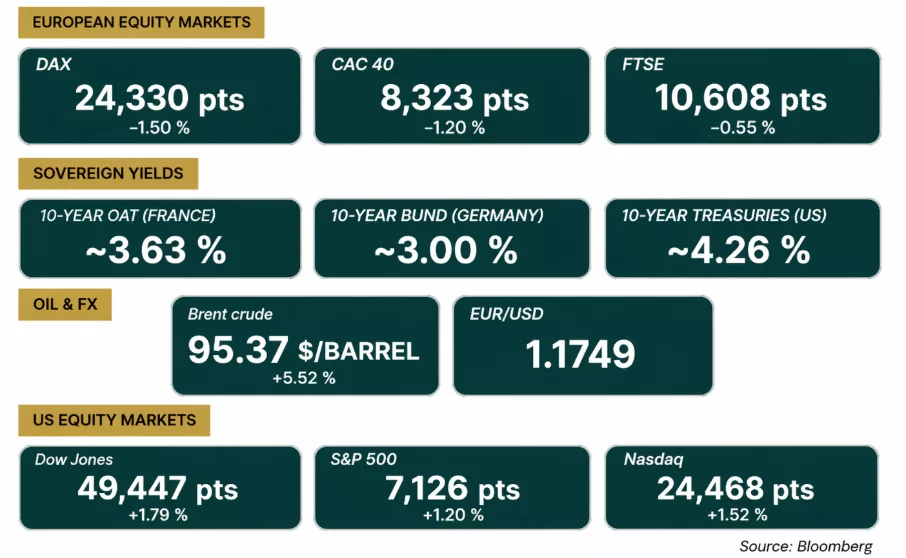
→ The reopening of the Strait of Hormuz announced Friday evening lasted only a few hours: Tehran reasserted control overnight from Friday to Saturday. European markets opened sharply lower on Monday, caught between renewed tensions and the imminent expiry of the truce on April 21. U.S. negotiators are traveling to Pakistan for a new round of talks.
→ Key events to watch this week: Q1 earnings from 15 CAC 40 companies, flash April PMI indices in the euro area and the U.S., UK inflation, and U.S. retail sales.
Outlook and implications for treasurers
The truce expires on April 21, and the reopening, followed by the closure, of the Strait of Hormuz within less than 24 hours highlights how volatile the situation remains. Three scenarios emerge around this key deadline.
Scenario 1: Durable diplomatic agreement (truce extended or renewed)
If the truce is renewed or extended, Brent would fall below $85–90, allowing for rapid disinflation. The 10-year OAT would decline toward 3.30–3.50%, reopening attractive issuance windows. The European Central Bank could consider maintaining rates or even modest easing by the end of 2026. The CAC 40 would move back above 8,500, supported by renewed risk appetite.
→ Take advantage of lower-rate issuance windows, recalibrate interest rate hedging, and reduce oil exposure through hedging strategies.
Scenario 2: Volatile status quo (alternating truces and breakdowns)
In this scenario, the most likely at this stage, truces and breakdowns would continue to alternate, keeping Brent in a $90–110 range. Uncertainty would remain elevated, with inflation above target and yields staying in a high range: OAT between 3.55% and 3.80%, limiting issuance to tactical windows. The ECB could raise rates at its April 30 meeting. Working capital requirements would remain under pressure, with volatile input costs and unpredictable cash flows.
→ Manage liquidity tactically, maintain precautionary buffers, avoid unhedged long exposures, and diversify counterparties.
Scenario 3: Confirmed escalation (breakdown of truce, resumption of hostilities)
In the event of a breakdown in the truce and renewed hostilities, Brent would exceed $110–120, triggering a major oil shock and placing the ECB in an unsolvable dilemma: tightening policy despite slowing growth. The OAT would rise above 3.80–3.90%, with higher funding costs and widening NEU CP spreads. The CAC 40 would fall below 8,000, with renewed systemic stress and a sharply higher risk premium.
→ Secure issuance windows immediately, extend maturities where possible, and reassess FX hedging policies.
The week of April 13–17 confirmed that markets can absorb a major geopolitical shock within hours, and reverse just as quickly. Friday’s announcement on Hormuz showed that the risk premium is now a short-term variable rather than a structural trend.
The April 21 deadline is the next focal point: extension of the truce or resumption of conflict. In any case, structural volatility is expected to remain elevated in the coming weeks, driven by Q1 earnings releases, central bank meetings at the end of April, and the day-to-day evolution of the U.S.–Iran situation.
For treasurers, the challenge is no longer to predict the outcome of the conflict, but to build structural resilience in a binary environment. Dynamic duration management, diversification of funding sources, and tight liquidity control are now more critical than ever.