
From geopolitical relief to monetary stress: When the middle east sets the pace for markets
Hopes of negotiations, a rebound in crude oil, and persistent pressure on sovereign yields. Since the outbreak of the U.S.–Israeli conflict against Iran on February 28, markets have been navigating in unstable territory.
Review of the past week
The entire week was shaped by developments in the U.S.–Israeli conflict against Iran. Markets fluctuated in response to contradictory statements from Washington and Tehran, leading to marked volatility across equities, bonds, and oil.
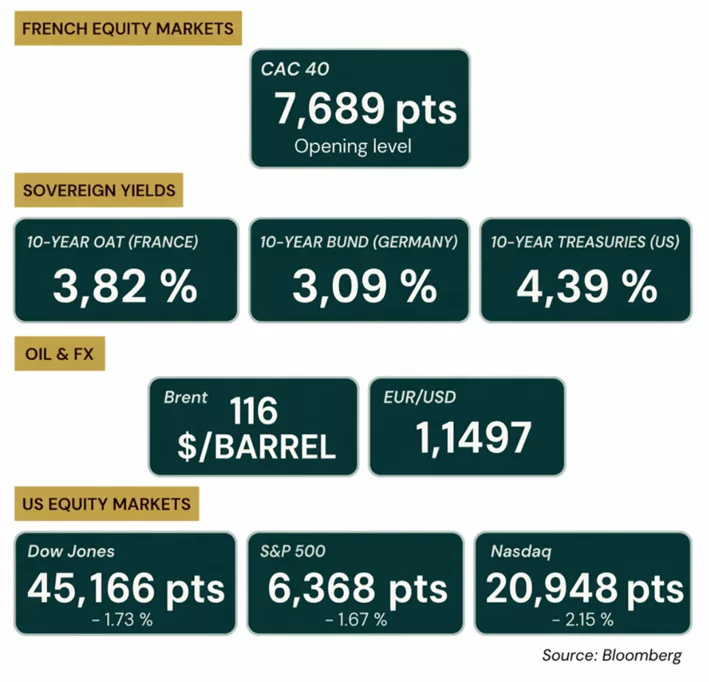
The CAC 40 illustrates this clearly: three consecutive sessions of gains followed by a pullback at the end of the week. Conflicting diplomatic signals between Washington and Tehran were enough to trigger this reversal.
Key figures
- CAC 40
03/23: +0.79% → 7,726 pts | 03/27: −0.93% → 7,701 pts - Brent crude
03/26: ~ $108/barrel (+5.74%) - 10-year OAT (France)
03/23: 3.873% | 03/25: 3.65% - 10-year German Bund
03/23: 3.077% (highest since June 2011) | 03/27: 3.098% - 10-year U.S. Treasury yields
03/23: 4.445% | 03/27: 4.441%
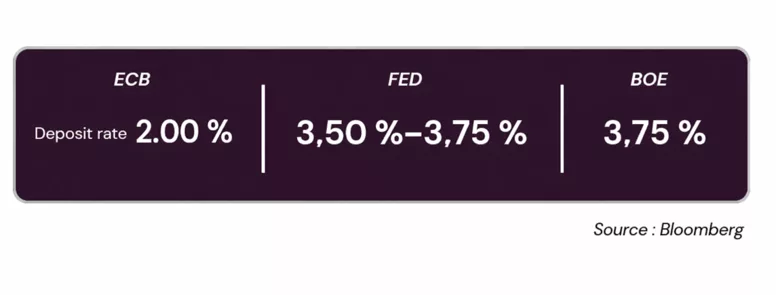
Central banks remained on the sidelines this week, but their stance evolved. Markets have now abandoned any expectation of rate cuts by the Federal Reserve in 2025 and are instead pricing in two rate hikes from the European Central Bank by July.
Current policy rates overview
Summary of key figures for the week of March 30
Outlook and implications for treasurers
If energy tensions persist and expectations of ECB tightening materialize, three scenarios deserve attention:
Scenario 1 : Rapid diplomatic resolution
Brent falls back below $95, and inflation stabilizes. Expectations of ECB rate hikes fade, returning to a maximum of two hikes by the end of 2025. Short-term spreads narrow.
→ A favorable window to lock in fixed-rate maturities before markets revert to a more accommodative scenario.
Scenario 2 : Prolonged conflict, sticky inflation
Brent fluctuates between $100 and $115, and inflation rises above target levels again. The ECB is forced to raise rates, with the probability of an April hike estimated at 77%. Sovereign yields remain elevated (10-year OAT around 3.70–3.90%). NEU CP / ECP spreads widen gradually.
→ A delicate trade-off between maintaining short-term flexibility and securing fixed-rate funding.
Scenario 3 : Significant escalation
In this scenario, a partial closure of the Strait of Hormuz would trigger a sharp oil shock, with Brent exceeding $120. Stagflation would loom, with declining growth and persistent inflation, placing central banks in an unsolvable dilemma. Liquidity stress would remain a risk, making NEU CP programs difficult to roll over.
→ Cash management becomes a top strategic priority, with reallocation toward the most liquid instruments (overnight to 1-week maturities).